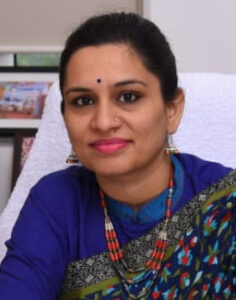
In the layered corridors of public administration, where authority often masks anonymity, Ms Nidhi Choudhari, IAS, has etched a presence that is both quietly formidable and enduringly humane. Her journey is not merely one of breaking barriers but of redrawing the contours of governance itself, with empathy, conviction and an unflinching commitment to public good.
There are officers who administer and there are those who transform the very grammar of administration. Ms Nidhi Choudhari belongs unmistakably to the latter. As Director of the National Gallery of Modern Art in Mumbai, she has reimagined what a cultural institution can mean in a restless, evolving metropolis. What was once a relatively subdued space has, under her stewardship, turned into a vibrant confluence of art, music, theatre and ideas, drawing diverse audiences into its fold. More than twenty exhibitions and over one hundred and forty cultural programmes in a span of nineteen months speak not merely of administrative efficiency but of a vision that seeks to democratise culture. Her initiatives have travelled beyond conventional boundaries, bringing tribal students from Palghar into the gallery space, introducing them not just to art but to possibilities.
Yet, to view her current role in isolation would be to miss the deeper arc of a career defined by firsts, and by the quiet dismantling of entrenched barriers. From becoming the first female Sub-Divisional Magistrate of Pen to the first woman CEO of Zilla Parishad Palghar, from stepping into the demanding role of Joint Commissioner in the Brihanmumbai Municipal Corporation’s encroachment removal department to serving as the first female District Collector of Mumbai Suburban, her journey reflects a pattern of entering spaces where precedent offered little guidance. Each role carried not just responsibility but the weight of expectation, and often, resistance.
Her early years, spent in a small village in Rajasthan and shaped by an education in government institutions, lend a certain groundedness to her administrative philosophy. It is this lived understanding of the margins that informs her approach to governance. For her, policy is not an abstract construct but a lived reality that must be felt and understood from the citizen’s vantage point. This insistence on participatory governance has remained a constant thread, whether she was facilitating land acquisition for National Highway 66 with remarkable speed and sensitivity or spearheading sanitation and digital learning initiatives that helped Palghar emerge as the country’s first tribal district to be declared open defecation free.
There is, in her narrative, a striking absence of self-congratulation. Instead, one encounters a candid acknowledgment of the ambiguities and contradictions that define public service. As a young officer, she undertook the demolition of dangerous structures ahead of the monsoon, an act rooted in public safety, only to face an FIR years later. The eventual institutional vindication did not erase the lesson it left behind. Public service, she realised, often demands courage without the assurance of recognition, and conviction without the comfort of validation.
A similar complexity marked her tenure as District Collector when she executed a High Court directive to remove a structure built in violation of coastal regulations, only to see the decision reversed later. For many, such reversals might breed disillusionment. For her, they became reminders of the unpredictable terrain of governance, where intent and outcome do not always align, and where resilience must coexist with detachment.
Her administrative imprint, however, is perhaps most visible in moments of crisis. During the COVID-19 pandemic, her foresight in facilitating the conversion of industrial oxygen into medical oxygen positioned Raigad as a critical hub during the second wave, a move that had tangible, life-saving consequences. The handling of Cyclone Nisarga and the swift disbursement of relief further underscored an ability to combine preparedness with responsiveness. These are not merely instances of efficiency but of leadership that anticipates, adapts and acts with urgency.
Even in domains that appear procedural, her interventions have carried a transformative edge. As Commissioner of Skills and Employment, her push to modernise Industrial Training Institutes and introduce contemporary courses signalled an understanding of the changing economic landscape. Her support for women-led enterprises through targeted policy initiatives reflected a commitment to inclusion that extends beyond rhetoric.
What emerges across these roles is a leadership style that blends firmness with empathy, and decisiveness with introspection. Whether it was removing encroachments along the Tansa pipeline despite resistance or implementing the plastic ban in Mumbai with sincerity, she has demonstrated a willingness to take difficult decisions, guided not by expediency but by principle.
At the core of her work ethos lies a deeply personal commitment to the idea of India. It is not a rhetorical flourish but a lived conviction that informs her choices and anchors her sense of purpose. There is also, notably, an enduring optimism in her outlook. She sees India not merely as an economy on the rise but as a society capable of becoming more inclusive and compassionate, provided governance remains attuned to both growth and equity.
For aspiring women leaders, her journey offers neither easy reassurance nor romanticised narratives. Instead, it presents a clear-eyed articulation of reality. Expectations must be tempered, resilience must be cultivated internally, and integrity must remain non-negotiable. She speaks of the need to accept failure without being defined by it, to choose the difficult right over the convenient wrong, and to carry confidence as a constant companion. Her counsel extends beyond professional advice into the realm of lived experience, addressing the often unspoken challenges of balancing personal and professional identities, and urging women to redefine success and self-worth on their own terms.
In a system where change is often incremental and resistance deeply embedded, Ms Nidhi Choudhari’s journey stands out not because it is dramatic but because it is deliberate. It is a story of persistence over spectacle, of substance over symbolism. In quietly occupying spaces that were once inaccessible, and in leaving them more open than she found them, she has contributed to a shift that is both structural and deeply human.
Her imprint on governance, much like her presence, is not loud. It is lasting.
A Column By
Raju Korti – Editor
The Resource 24X7
A Journalist With 4 Decades of Experience With Leading Media Houses.