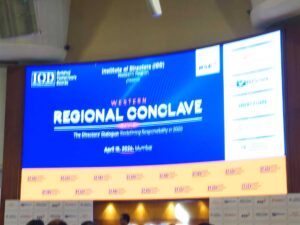
From Saraswat Bank’s inspiring story of ₹1 lakh crore transformation to the rise of AI-enabled fraud, the IOD Western Region Conclave’s Financial Governance panel delivered a sharp message: in a world saturated with data, the scarcest and most valuable resource remains human accountability.
Financial Governance, Board Accountability, ESG, Risk Management, Ethics, Saraswat Bank, NPCI, IOD 2026, Cooperative Banking, Director Fiduciary
A profound truth emerged early in the Directors’ Dialogue 2026’s Financial Governance session: accountability does not conclude at the threshold of compliance. It is precisely where compliance ends that true accountability begins.
The panel opened with a striking contrast between two archetypes of boardroom culture. In one, the board operates like a traffic officer — anchored in rules, reactive enforcement, and the comfortable certainty of black-and-white regulation. In the other, the board functions as a compass — proactively interrogating the horizon, asking not merely “Are we permitted?” but “Are we prepared? Are we principled? Are we sustainable?”
The distinction, panellists stated, was not a cosmetic one but an existential one.
The Saraswat Bank Story: Governance as Competitive Advantage
Nowhere was this distinction more vivid than in the story of Saraswat Bank, shared by Chairman Gautam Thakur. The bank’s journey from ₹4,000 crore to over ₹1 lakh crore — making it Asia’s largest cooperative — is, at its core, a governance story. A bold board vision, the discipline to correct course when wholesale banking pushed non-performing assets to 6.5%, the early adoption of risk frameworks, and an unwavering ethics committee were the real competitive advantages, not market conditions or luck.
“Never lose your core while you grow. Markets reward performance today; tomorrow, they will reward performance combined with governance and integrity. That combination is what builds institutions that last.” — Gautam Thakur, Chairman, Saraswat Bank.
The session was equally direct about the transformation required in how directors engage with financial information.
Pranay Ranjan Dwivedi, Managing Director and CEO of SBI Pension Funds, articulated five dimensions of financial stewardship for the modern board: reading the risk behind the numbers; technology governance that asks not just “can this be done?” but “should it be done this way?”; embedding ethics and culture in everyday institutional behaviour; pairing accountability with genuine competence and continuous learning; and consciously balancing growth, risk, and public purpose.
Foresight Over Hindsight: The Technology Dimension
Shweta Dasgupta, Head of Product at NPCI Bharat BillPay, brought the digital dimension into sharp relief. AI is moving at a blistering pace, she observed, and boardrooms must adapt by shifting from hindsight to foresight. The most uncomfortable reality for directors is being accountable for an entire organisation while having visibility into only parts of it. The solution lies in designing compliance into systems from the outset — making technology a proactive enabler rather than a reactive blocker.
The tax regulatory perspective, offered by Prashant Patil of the CBIC DG System Directorate, introduced an unexpected note of collaboration. Regulatory notices, he suggested, are not threats to be feared — they are a review and correction model for organisational safety. India’s tax framework is actively moving toward decriminalising most offences through new codes, with regulators positioning themselves as facilitators for job and wealth creation.
“The biggest governance myth is that more controls equal better governance. Directors must have the courage to hear the ‘hidden noise’ and ask the unheard questions beyond the polished board pack.” — Jaya Janardanan, Independent Director on Multiple Boards
Jaya Janardanan also urged directors to confront a different kind of governance failure: the abdication of judgment in the face of data. When spreadsheets substitute for wisdom and algorithms replace conscience, governance hollows from within. The most dangerous outcome is not non-compliance, she argued, but under-judgment: implementing circulars without asking whether they actually improve the business, and remaining compliant at the cost of the organisation’s long-term profitability.
The message that unified the session was as clear as it was compelling. In a world saturated with data, the scarcest and most valuable resource remains human accountability — the willingness of a director to look past the polished board pack, ask the questions no one wants to hear, and stand behind the answers with both their name and their institution’s future on the line.
Through events like the Directors’ Dialogue, the Institute of Directors is building precisely this culture — one where financial governance is not a ritual of retrospective review, but a living discipline of foresight, integrity, and institutional courage that India’s ambitions demand and deserve.
Disclaimer: This article is based on the Financial Governance session of the IOD Western Region Conclave 2026. The Institute of Directors champions professional standards in board governance and director development across India.