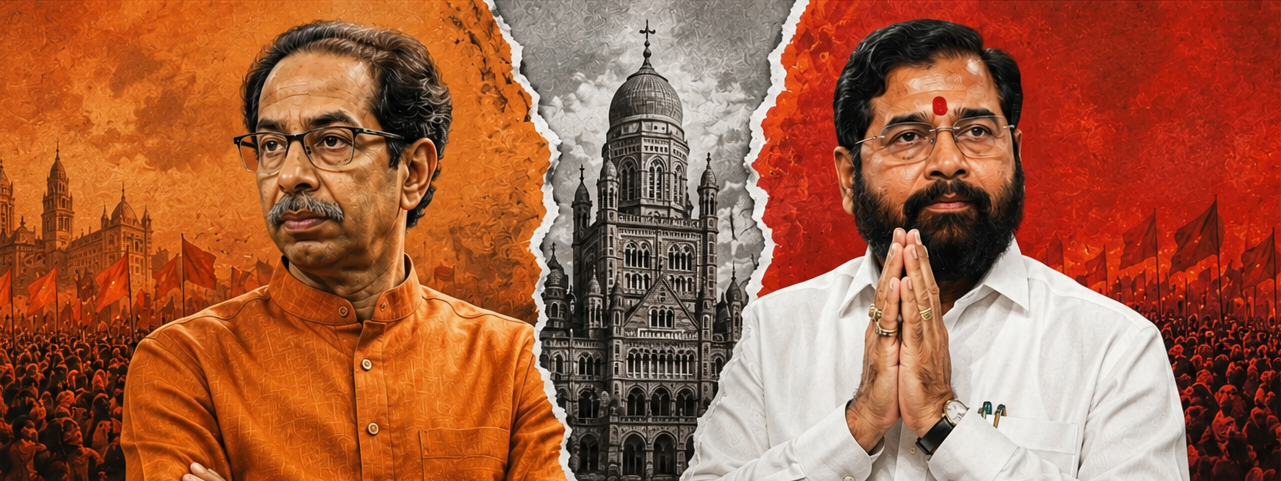
The political landscape of Maharashtra has undergone a dramatic transformation since the vertical split in the Shiv Sena in 2022. For over five decades, the party founded by Balasaheb Thackeray dominated Mumbai’s municipal politics and remained one of the most influential regional forces in India. However, the emergence of two rival factions, respectively led by Uddhav Thackeray and deputy chief minister Eknath Shinde, has fundamentally altered the party’s electoral fortunes and political relevance.
Today, the Thackeray Sena faces perhaps the greatest challenge in its history. The loss of the party’s traditional symbol, organizational network, elected representatives and a significant section of its cadre has considerably reduced its political space. While the party continues to enjoy emotional support among stray sections of voters, its long-term prospects depend upon its ability to reinvent itself amid changing political realities.
Founded in 1966 by Balasaheb Thackeray, the Shiv Sena began as a movement championing the rights of the “Marathi Manoos” or Sons of the Soil. Over time, it evolved into a major political force combining Marathi regionalism with Hindutva. The alliance with the Bharatiya Janata Party (BJP) from the late 1980s enabled the party to expand beyond Mumbai into several parts of Maharashtra and capturing the chief ministerial position in 1995. The Sena recovered even after demise of Balasaheb.
The turning point, however, came after the 2019 Assembly elections when Uddhav Thackeray broke the long-standing alliance with the BJP and formed the Maha Vikas Aghadi (MVA) government with the Nationalist Congress Party (NCP) led by Sharad Pawar and the Congress. While the move enabled him to become the CM, it alienated a section of Shiv Sena’s traditional ideological supporters who viewed the alliance as inconsistent with the party’s long-standing political identity which proclaimed a pro-Hindutva stand.
The political crisis reached its climax in June 2022 when Eknath Shinde led a rebellion and weaned away majority of Shiv Sena MLAs to his faction. With little effort, Shinde was able to become the CM, supported by the BJP which asked former chief minister Devendra Fadnavis to work under Shinde. The subsequent decisions by constitutional authorities and election regulators recognized the Shinde faction as the official Shiv Sena and awarded it the party’s traditional “Bow and Arrow” symbol. This represented not merely an organizational setback but a psychological blow to the Thackeray camp though the matter is still sub-judice.
The Thackeray faction has since struggled to maintain its earlier dominance. While it continues to command sympathy among loyal supporters, electoral success has become increasingly difficult for it. Several factors have contributed to this constant decline.
The principal reason is loss of organizational machinery. A substantial number of legislators, Members of Parliament, local body representatives and grassroots workers shifted to the Shinde faction as they felt their future would be bleak under Uddhav. Organizational rebuilding was relegated by him, almost halting the process. The main grievance of the workers has been that Uddhav is not accessible, particularly for those coming in from rural Maharashtra.
As a result of loss of political power, the Sena under Uddhav started suffering from reduced financial Resources. It is a known fact that political parties rely heavily on fiscal muscle and organizational infrastructure. The split affected the Thackeray faction’s financial and logistical capabilities. It is hence significant to note that most elected representatives who have left Uddhav complain in unison that they are deprived of governmental support for development works in their constituencies.
Even as Uddhav Sena was contracting its voter base, it continued to compete for the same voter bank segment. On the other hand, irresponsible outbursts by some of its spokesmen against Gujarati and North Indian communities eroded its acceptability. The division has fragmented what was once a consolidated support base.
Uddhav Thackeray’s reliance on Maha Vikas Aghadi partners off and on has generated an unease in MVA since it has consistently suffered in every election held in Maharashtra over the past two years. Along with the Sena, even the Congress and the NCP (SP) find their presence shrinking. While coalition politics is expected to broaden electoral appeal, it has actually limited independent political identity of all the three parties.
For decades, the Brihanmumbai Municipal Corporation (BMC) had been the unified Sena’s principal power centre. Control over the BMC provided administrative influence, financial resources and political visibility at the national level. Even though the Thackeray faction continues to retain significant clout in Mumbai in civic elections, its dominance in legislature and parliament in Mumbai is no longer assured.
The BJP has considerably expanded its urban base over the past decade. Simultaneously, the Shinde Sena has gained access to government resources and organizational support. This three-cornered competition makes future municipal elections far more unpredictable than in the past. Losing control over Mumbai’s civic administration has further diminished the Thackeray faction’s influence in Maharashtra politics.
It is generally accepted that Uddhav Thackeray enjoys certain political strengths. He is regarded by supporters as a moderate, sober leader capable of building broad coalitions and handling challenging situations, like the way he faced the COVID pandemic. His handling of the pandemic earned him appreciation from several sections of society.
However, critics argue that the party under his leadership gradually moved away from Balasaheb Thackeray’s aggressive political style, especially the Hindutva ideology. The decision to ally with ideological rivals created confusion among traditional supporters, while the organizational structure became increasingly centralized around the Thackeray family.
Another challenge is leadership transition. Uddhav’s son Aaditya Thackeray represents a younger generation of leadership and has emerged as an articulate political figure. Yet his appeal remains concentrated among urban and educated voters. Expanding that appeal into rural Maharashtra remains an important task.
Whereas the BJP has established itself as the state’s dominant political force with a broad social coalition extending beyond urban centres, the Shinde faction has concentrated on bringing important opposition figures into its fold. This has hit the Thackeray Sena and the NCP (SP) very hard, further reshaping political equations across the state.
It is underscored by the recent developments that such an environment, regional identity alone may no longer guarantee electoral success. Voters increasingly evaluate parties based on governance, welfare delivery, infrastructure development, employment generation and leadership stability.
Loyal Sainiks feel that Thackeray must redefine his political narrative beyond emotional attachment to Balasaheb Thackeray’s legacy and emerge as a leader in his own right.
Hence, Thackeray’s and his Shiv Sena’s future depends upon more than public sympathy. It requires organizational discipline, ideological clarity, effective grassroots leadership and a compelling development agenda. The party must decide whether it wishes to primarily represent Marathi regional aspirations, to continue emphasizing secular coalition politics,to revive its traditional Hindutva positioning, or evolve as a new synthesis that addresses contemporary aspirations such as employment, urban infrastructure, industrial growth, education and digital opportunities.
Youth engagement will also be critical. Maharashtra’s younger electorate increasingly prioritizes economic mobility, entrepreneurship, technology and quality public services over traditional identity politics. The party’s ability to address these aspirations will determine its long-term relevance.
Overall, it is clear that the Thackeray Sena stands at a historic crossroads. Once the unquestioned political voice of Mumbai and a dominant regional force, it now confronts organizational fragmentation, electoral competition and ideological repositioning. Although the emotional legacy of Balasaheb Thackeray continues to provide the party with a committed support base, this appeal alone cannot ensure sustained political success.
The coming decade will determine whether Thackeray successfully reinvents his Sena as a modern regional party capable of adapting to Maharashtra’s evolving political landscape or gradually recedes into a secondary role within coalition politics. Its future will depend not merely on preserving its past but on convincing a new generation of voters that it offers a credible vision for Maharashtra’s economic development, governance and social aspirations.
A Column By
Dilip Chaware – Senior Editor
A media professional for 43 years, with extensive experience of writing on
a variety of subjects; he is also a documentary producer and book author.