
The decision by the Brihanmumbai Municipal Corporation (BMC) to act against the hutments measuring 14 feet or more in height has opened an important debate about the future of Mumbai’s informal settlements. Municipal Commissioner Ashwini Bhide has announced a three-month drive beginning October 1, following a series of fatal incidents involving unsafe and unauthorised structures. At the same time, corporators across party lines have opposed the manner and scope of the proposed action, arguing that demolition cannot become a substitute for rehabilitation and that elected representatives should have been consulted before taking such a drastic step.
The issue therefore goes well beyond a dispute between the civic administration and politicians. It raises a fundamental question: how can Mumbai simultaneously protect human life, enforce building regulations and provide humane housing solutions to its economically vulnerable residents?
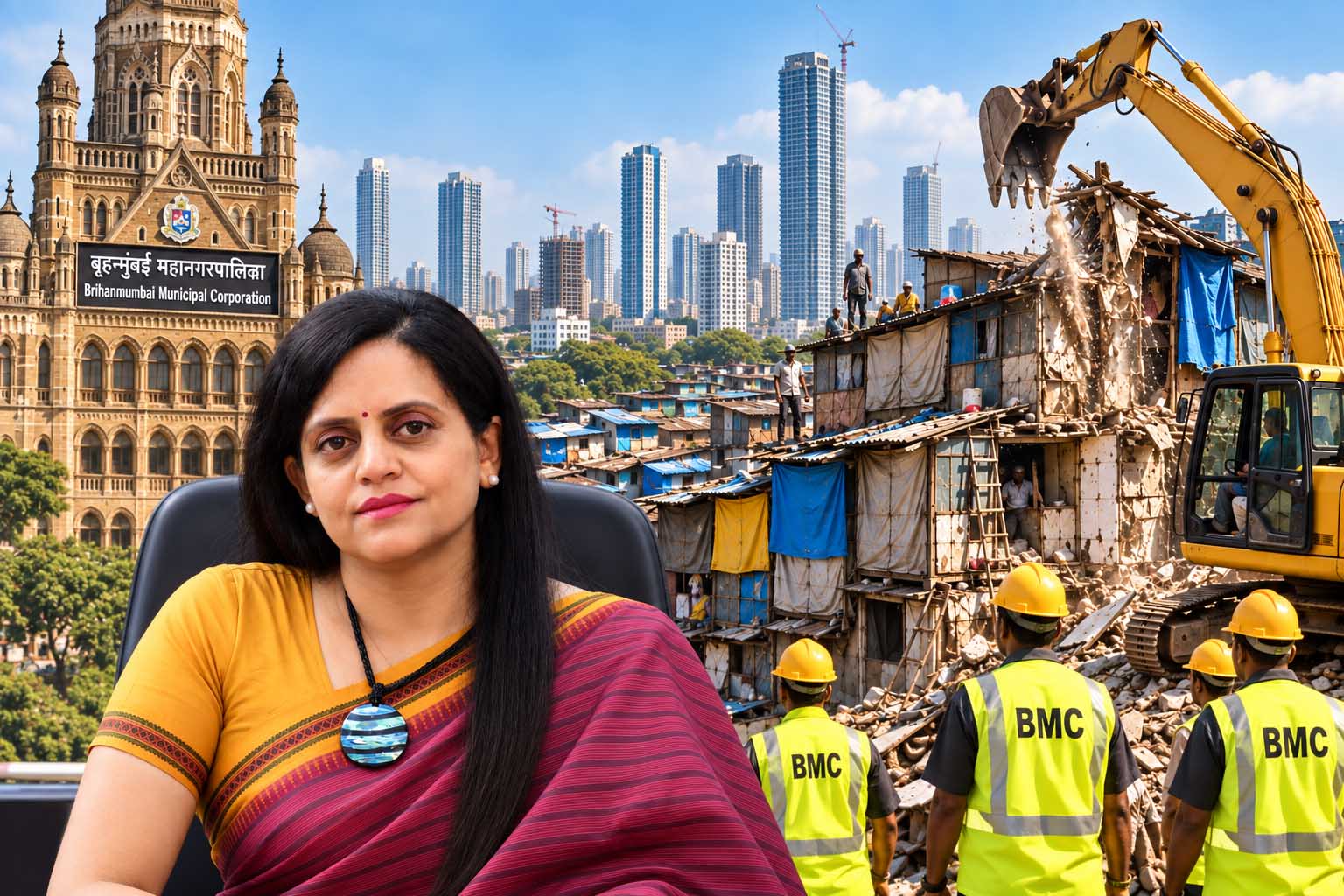
Safety, Regulation and Politics of Rehabilitation
Mumbai’s struggle with unauthorised construction is as old as its extraordinary growth. As land prices rose and formal housing became increasingly unaffordable, informal settlements expanded across the metropolis. Over decades, many hutments that began as single-storey structures have acquired additional floors, sometimes without any structural assessment or regard for safety or planning regulations.
The Brihanmumbai Municipal Corporation has now decided to confront one particularly dangerous aspect of this scenario : hutment structures that exceed the permitted 14-foot height. The BMC has identified 39111 structures that are 14 feet in height or taller, among approximately 2.23 lakh slum structures. Of these, 31227 are in the eastern suburbs, 4536 in the western suburbs and 3348 in the island city. The proposed drive is scheduled from 1st October till 31st December 2026.
Justification is public safety
Mumbai has witnessed several tragedies involving unauthorised and structurally vulnerable structures. In July, six people, including five children, died when a house collapsed in Mankhurd in the eastern suburbs. The incident prompted commissioner Ashwini Bhide to announce intensified action against the slum structures that defied the regulations, including that about the height. A landslide at Kurla in August claimed eight lives. Recent action by the BMC after the deaths caused by toxic fumes at a public toilet in Goregaon East illustrates another dimension. The civic body demolished more than 50 unauthorised structures around the facility, saying the encroachments contributed to waste accumulation and hazardous conditions. Such tragedies have hardened the BMC’s resolve.
From the civic administration’s perspective, waiting for another disaster before acting would be difficult to justify. A multi-storey hutment constructed without proper foundations, columns, structural calculations or adequate access for emergency services can and does become a serious hazard. The problem is particularly acute when additional floors are added gradually for residential or rental purposes.
There is also a larger urban-planning issue. Unauthorised construction can obstruct roads and footpaths, encroach upon nullahs and drainage channels, occupy government land and complicate the provision of water, sanitation, electricity and emergency services. In certain locations, such structures can increase risks from flooding, fire, landslides and building collapse. Moreover, they impede completion of crucial civic projects.
Seen from this perspective, enforcement is not merely an aesthetic exercise. It is connected directly with the safety of residents themselves.
If so, can the opposition from corporators be dismissed as resistance to civic discipline and keeping an eye on their vote banks?
The principal concern raised by representatives of different political parties is that a height-based criterion alone may not adequately distinguish between genuinely dangerous structures and the structures that can be strengthened, regularised or incorporated into rehabilitation schemes.
Corporators have also questioned why the administration chose 14 feet as the decisive threshold and why elected representatives were not consulted before the announcement. BJP House leader Ganesh Khankar, for example, sought suspension of the drive, while other corporators across parties demanded clearer rules and consultation. This criticism deserves consideration. But it should be considered with caution.
Mumbai’s slums are not merely collections of illegal structures. They are communities in which several generations have lived, worked and established social networks. For many residents, demolition means losing not just a roof but also proximity to employment, schools, transport and social support.
Opponents have also raised the question of rehabilitation. The administration itself has acknowledged that the legal status of occupants differs and that rehabilitation may have to be considered under applicable schemes. There is an argument that unauthorised housing units constructed before 2011 are subject to rehabilitation requirements before demolition under the applicable state framework.
That makes a blanket approach problematic. There is an important difference between saying that unauthorised construction should not be permitted to expand and saying that every existing structure above a specified height should automatically be demolished irrespective of its location, structural condition, occupancy status or rehabilitation possibilities.
The first proposition is primarily about enforcement. The second involves a complex housing and social-policy question, making it a socio-economic-human issue.
Corporators have therefore sought greater consultation and rehabilitation arrangements. Congress representatives have called for due process and the use of mechanisms such as the Slum Rehabilitation Authority, MHADA and other redevelopment schemes. Shiv Sena (UBT) representatives have also demanded verification of eligibility before action.
Legitimate concern: enforcement must be consistent
If the BMC acts firmly against a certain category of residents while unauthorised constructions elsewhere are allowed to flourish for years, public confidence in the exercise will suffer. The civic administration, therefore, needs to demonstrate that the campaign is based on transparent criteria rather than selective enforcement.
On the political front at the same time, the opposition faces its own difficult choice. Corporators are elected to represent not just their parties but also the residents, including slum dwellers in their constituencies. Their responsibility to protect constituents from arbitrary or unjust action is legitimate. But elected representatives also have a responsibility to recognise the consequences of unsafe construction. Opposition to demolition should, therefore, not translate into opposition to safety enforcement itself.
The most constructive position would be to separate the objective from the method. The objective is to prevent unsafe, unauthorised multi-storey construction. Academically thinking, it can be supported as a matter of public safety. The method employed should be subjected to careful scrutiny. Before demolition, every identified structure could be categorised according to factors such as structural stability, location, encroachment on hazardous land, obstruction of drainage or public infrastructure, fire accessibility, occupancy status and eligibility for rehabilitation.
A transparent survey will make the process more credible. Residents should receive notices and an opportunity to establish their eligibility wherever applicable. Structures posing an immediate and demonstrable danger should receive priority, while cases where rehabilitation is required should be processed through the appropriate housing mechanism.
The BMC and elected representatives should also work together on a clear standard operating procedure. The administration has already faced criticism for announcing the drive without adequately consulting the civic house. The political confrontation became so intense that the BMC general body meeting was adjourned after a prolonged debate and due to the commissioner’s absence from the floor.
That confrontation is unnecessary if institutional mechanisms for consultation are used.
There is also a lesson for the future. Demolition is ultimately a symptom of a larger housing crisis. Mumbai needs more affordable formal housing, faster redevelopment, better rental-housing policies and stronger enforcement against new illegal construction. If affordable housing remains inaccessible, demolition alone will simply relocate the problem.
The 14-foot issue should, therefore, become an opportunity to create a more comprehensive policy for informal settlements. Every new unauthorised floor should be prevented from coming up. Dangerous structures should be dealt with promptly. At the same time, legitimate rehabilitation rights should be protected and eligible families should not be left homeless.
The political debate surrounding Ashwini Bhide’s decision thus has two legitimate dimensions. The administration has a responsibility to prevent avoidable deaths and enforce building regulations. Corporators have a responsibility to ensure that enforcement is transparent, consultative and with a human touch.
The real test of civic governance will be whether these two responsibilities can be reconciled to create a better Mumbai. A safer Mumbai cannot be built by ignoring illegal construction. Similarly, a humane Mumbai cannot be built by ignoring the people who live in it.
The way forward lies in strict action against dangerous and new unauthorised construction, transparent identification of genuinely vulnerable structures, due process for affected residents and rehabilitation wherever legally and administratively required. Such an approach would allow safety and social justice to reinforce rather than undermine each other.
For a city as complex as Mumbai, that balance is not merely desirable. It is essential.
The strongest policy distinction is between preventing dangerous construction and removing existing residents without a workable rehabilitation pathway. The current cross-party dispute makes that distinction particularly important with the civic drive already underway.
A Column By
Dilip Chaware – Senior Editor
A media professional for 43 years, with extensive experience of writing on
a variety of subjects; he is also a documentary producer and book author.