The proposed foreign tour of Rashtriya Swayamsevak Sangh (RSS) Sarsanghchalak Mohan Bhagwat, beginning August 25, is far more than an overseas engagement by the head of a mammoth organisation, which describes itself as a socio-cultural organisation. It is expected to mark an important stage in the evolution of the RSS, with implications for Indian politics, diaspora relations, cultural diplomacy and international understanding of India’s ideological landscape. Bhagwat is scheduled to visit the United States, Canada and the United Kingdom at the invitation of overseas organisations associated with the Indian diaspora. A major public programme is scheduled in New York on August 29.
An important historical correction, however, is necessary. Bhagwat is often described as the first RSS chief to travel abroad. He is not. The RSS’s own records note that fourth Sarsanghchalak Rajendra Singh, popularly known as Rajju Bhaiyya, travelled to Kenya in 1997 and Japan in 1998. Bhagwat is instead the first RSS chief to undertake such a major, three-country Western tour in the present era with a specific tour agenda.
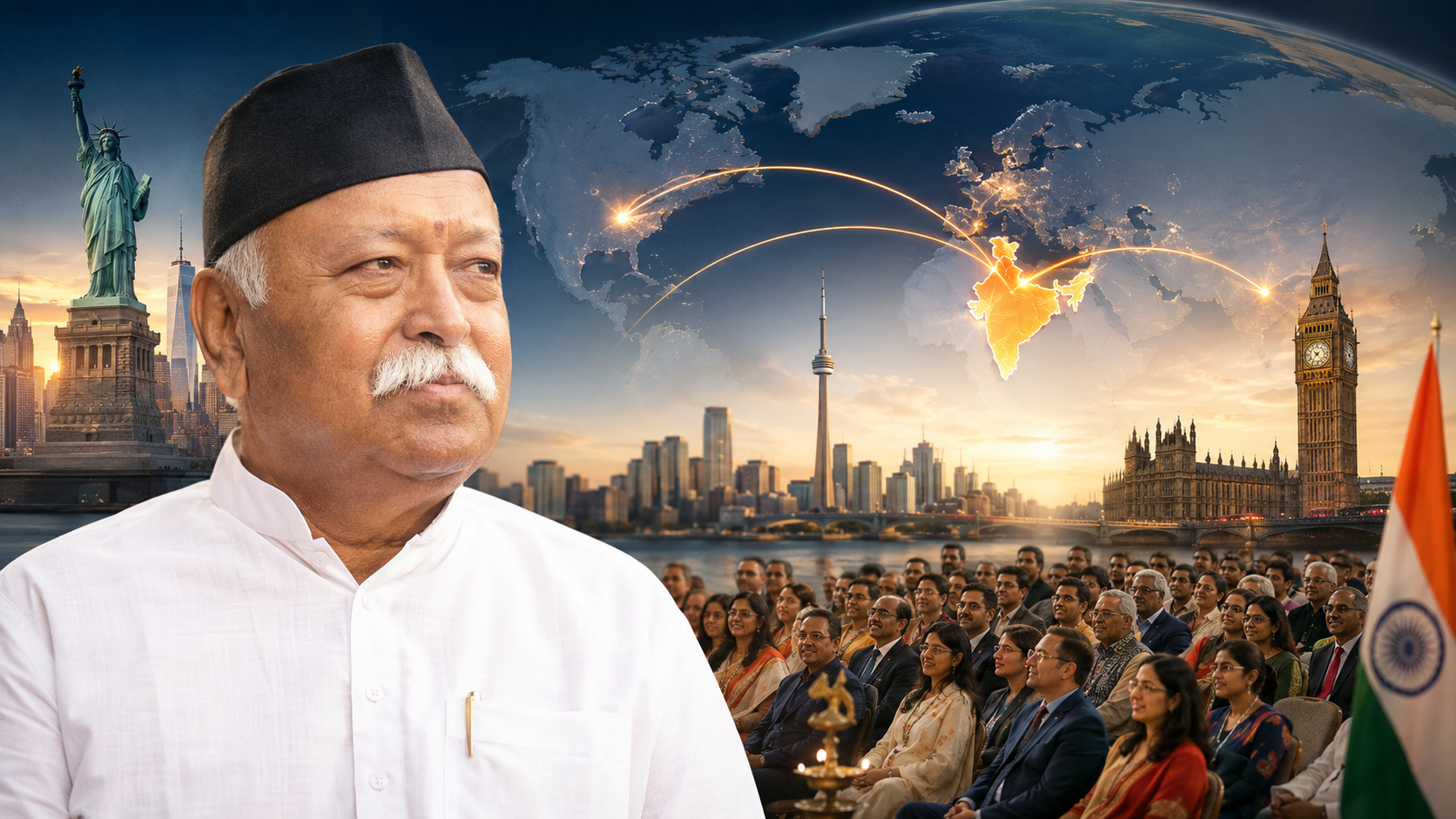
This distinction underscores the fact that while earlier overseas visits of the RSS chief were limited and connected largely with specific programmes or organisations, Bhagwat’s tour represents a much more systematic effort to place the RSS and its worldview in direct conversation with Indian diaspora and wider international audiences.
The timing is particularly significant. The RSS completed 100 years in 2025, and the centenary has provided an opportunity for introspection, expansion and outreach beyond its traditional organisational base. Foreign engagement can therefore be viewed as a logical extension of the organisation’s centenary-era outreach.
From an India-Centric Organisation to a Global Conversation
For most of its history, the RSS has remained primarily India-focused. Its emphasis has been on organising and strengthening Hindu society and contributing to nation-building through shakhas, cadre development, personal contact and voluntary service. International publicity was never central to its organisational culture.
The world around it, however, has changed and so has the RSS. Millions of people of Indian origin now live across North America, Britain, Europe, Africa, the Gulf and elsewhere. They are no longer merely migrants maintaining emotional links with India. They include influential professionals, entrepreneurs, academics, scientists, technology specialists, elected representatives and community leaders.
Bhagwat’s visit acknowledges this transformation. The Indian diaspora has acquired considerable social, economic and political influence in its adopted countries while retaining strong cultural connections with India.
His New York appearance on August 29 is therefore symbolically important. Organised with the participation of American Hindu, cultural, spiritual, service and community organisations, the programme focuses on social cohesion, civic participation, interfaith understanding and global harmony. It gives Bhagwat an opportunity to explain the RSS directly rather than leaving its image to be defined exclusively by supporters or critics.
Implications for Indian Politics
The political ramifications of the tour will inevitably attract attention. The RSS is not a political party, and Bhagwat does not hold any public office. Yet the organisation’s ideological influence on the wider Sangh Parivar and its longstanding relationship with the Bharatiya Janata Party make major statements by its chief politically consequential.
Meetings with Indian-origin professionals, academics, entrepreneurs and community leaders in the West will consequently be viewed through an Indian political lens. The RSS is likely to stress that its international engagement is cultural and social rather than partisan. That distinction will be important, but international audiences will naturally ask how its ideas relate to contemporary India, the BJP, Hindu identity, nationalism, social harmony and constitutional democracy.
Bhagwat will emphasise on the RSS’s conception of Indian civilisation, pluralism, social responsibility with a view to contributing to a broader understanding of an organisation often portrayed abroad through sharply polarised political narratives. At the same time, the tour has started attracting criticism and pointed questions, including concerns about religious freedom and the RSS’s influence in India. The discordant sentiments are expressed in both, India and the USA.
The Diaspora’s Strategic Importance
Bhagwat’s interaction with Indian communities in the three nations will contribute to a broader form of cultural diplomacy. There will not be any official veneer to it. Nevertheless, India’s international image is shaped by much more than embassies and governments. Civil society, spiritual traditions, cultural organisations, intellectuals and the diaspora also influence how India is perceived. Within that wider ecosystem, the RSS is undeniably an influential institution.
A New Phase of RSS Internationalisation?
Bhagwat’s journey also follows overseas engagements by other senior RSS functionaries. Sangh secretary general (Sarkaryavah) Dattatreya Hosabale visited the UK, US and Germany earlier in 2026 as part of centenary-year activities involving scientific, technological and community circles. This indicates that Bhagwat’s tour should not necessarily be seen as an isolated event but as part of a gradual internationalisation of RSS outreach.
The organisation could increasingly seek dialogue with universities, think tanks, professionals, religious leaders, technology communities and civil-society organisations. Such engagement could eventually broaden the subjects through which the RSS presents itself internationally—from India’s internal social and cultural questions to globalisation, civilisational dialogue, family values, environmental responsibility, social service, cultural identity and India’s role in a changing world.
A Test of India’s Soft Power
Bhagwat’s tour will also test whether India’s civilisational narrative can travel successfully beyond its borders. The RSS frequently presents India as a civilisation emphasising harmony rather than uniformity and a cosmic approach rather than isolation. Bhagwat has also described its conception of Hindu identity as inclusive and linked to responsibility toward society and nation.
The larger canvas of explaining the ideas associated with the RSS and their relevance to a world confronting cultural fragmentation, identity conflicts, technological disruption will be the basis of Bhagwat’s discourses.
The Road Ahead
The August 25 journey will become a milestone in the RSS’s second century. It will not be an exaggeration to suggest that the RSS chief’s maiden foreign tour will transform the organisation’s international image.
Its importance also lies elsewhere. On a scale much larger than earlier overseas engagements, the RSS chief will personally enter the global arena and engage communities that have a direct stake in India’s rise. The tour will inevitably attract supporters, sceptics, journalists, academics and political opponents. That is unavoidable when the head of such an influential organisation travels to three major Western democracies.
The real measure of achievement of the objective will how the visit generates a substantive conversation about India—its civilisation, democracy, diversity, aspirations and place in the world as a competing economic power.
The symbolism is unmistakable. The RSS began in Nagpur, which is Maharashtra’s second capital, in 1925. In its centenary era, its chief is preparing to meet directly the Indians and people of Indian origin who have made a difference with the dint of their hard work and their peaceful assimilation in local societies, not allowing any tensions to generate.
The journey therefore represents more than the crossing of national borders. It marks an important psychological shift: the RSS increasingly sees its ideas, influence and responsibilities in a global context.
That is why Mohan Bhagwat’s August 25 departure deserves to be watched not merely as an RSS event, but as a significant development in the evolving relationship between Indian politics, Indian civilisation, the diaspora and India’s place in the international order. Maharashtra will thus add another feather to its trans-national role in the process of making India a great nation.
A Column By
Dilip Chaware – Senior Editor
A media professional for 43 years, with extensive experience of writing on
a variety of subjects; he is also a documentary producer and book author.