The latest data of the National Crime Records Bureau (NCRB) presents a deeply disturbing picture of suicides in India. Maharashtra continues to occupy the first position in the country in terms of the absolute number of deaths by suicide. The figures should not merely be treated as a statistical ranking. Behind every number is a human life, a family and a social tragedy.
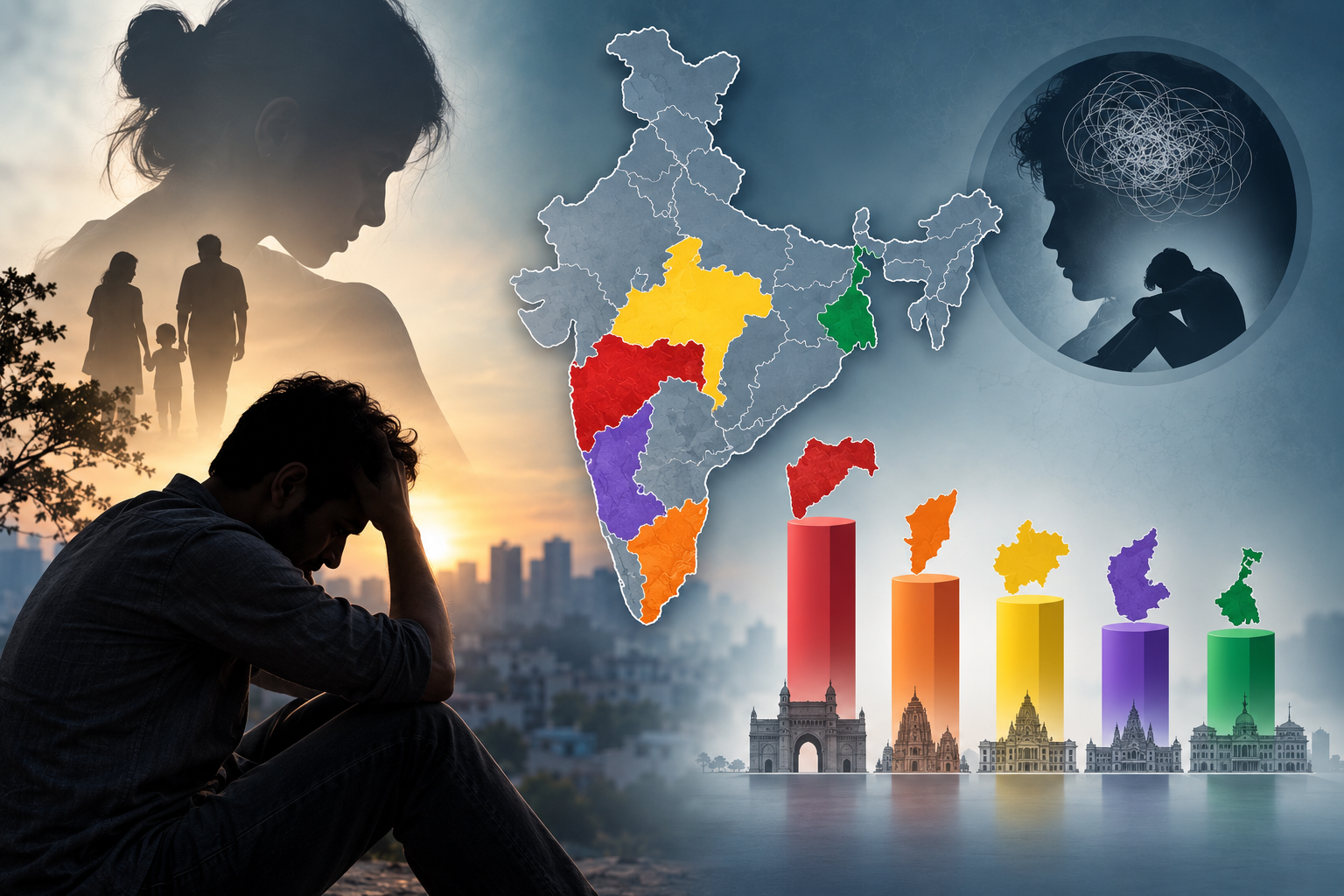
According to the NCRB’s Accidental Deaths & Suicides in India 2024 report, India recorded 1,70,746 deaths by suicide in 2024, marginally lower than 1,71,418 in 2023. The national suicide rate also declined slightly, from 12.30 to 12.20 per lakh population. Maharashtra recorded 22,174 suicides, accounting for about 13 per cent of the national total.
Maharashtra was followed by Tamil Nadu with 19965, Madhya Pradesh with 15491, Karnataka with 13151 and West Bengal with 12931. Remarkably, these same five states have occupied the top five positions for three consecutive years—2022, 2023 and 2024—and together accounted for almost 49 per cent of all suicides reported in India in 2024.
Absolute numbers tell only part of the story
Maharashtra’s first position requires some elaboration. It is among India’s most populous states and has a large urban population. Therefore, a comparison based purely on the number of suicides can be misleading. Population-adjusted suicide rates provide another perspective.
Several smaller states and Union Territories have substantially higher suicide rates. The 2024 national rate was 12.20 per lakh, while major urban centres recorded an even higher rate of 16.30. The 53 mega cities together reported 26150 suicides.
This distinction is important. Maharashtra has the largest absolute burden, but it is not necessarily the state with the highest suicide rate. States such as Kerala and several smaller north-eastern states have, at various times, recorded considerably higher population-adjusted rates. Thus, Maharashtra’s position should be understood as a combination of its huge population, extensive urbanisation and the particular social and economic stresses experienced by its population.
A changing trend
The long-term trend is nevertheless worrying. India recorded about 1.34 lakh suicides in 2015; the figure has subsequently risen to around 1.7 lakh annually. Although there are year-to-year fluctuations, the broad picture is of a persistently high suicide burden. There has also been a significant change in the occupational and demographic composition. Daily-wage earners have emerged as one of the most vulnerable groups. In 2024, they accounted for roughly 31 per cent of all suicide deaths nationally. Maharashtra recorded 6811 suicides among daily-wage earners, second only to Tamil Nadu’s 10556.
At the same time, the share of people engaged in farming who died by suicide has declined—from 8.70 per cent in 2016 to 6.20 per cent in 2024. This does not mean that agrarian distress has disappeared; rather, the suicide problem has become broader and increasingly encompasses urban and non-agricultural communities.
The student population presents another serious warning. Student suicides rose from 8068 in 2014 to 14488 in 2024, an increase of roughly 80 per cent. Maharashtra recorded the highest number of student suicides in 2024—1909—followed by Uttar Pradesh, Madhya Pradesh and Tamil Nadu.
Why are people taking this extreme step?
There is no single explanation for suicide. It is usually the culmination of several pressures rather than one isolated event.
Family problems remain the biggest recorded cause. In 2024, family problems accounted for about 35 per cent of suicides nationally, followed by illness at 17.90 per cent. Family conflict, marital difficulties, domestic violence, separation, loneliness and the breakdown of traditional support systems can push vulnerable individuals into despair. Ironically, at a time when communication has become easier through technology, meaningful personal communication within families can sometimes become weaker.
Economic insecurity is another major factor. Debt, unemployment, unstable employment, business losses and poverty can create a feeling of hopelessness. NCRB data indicates that 62.90 per cent of suicide victims in 2024 came from families with an annual income below ₹1 lakh.
Maharashtra’s economic prominence does not protect everyone from such pressures. Its huge informal workforce, migrant population, farmers facing uncertain incomes, small entrepreneurs and daily-wage workers are all exposed to economic shocks.
Illness, particularly chronic or debilitating illness, is another major factor. Medical expenses, physical suffering, loss of independence and the emotional burden placed on families can become overwhelming.
Then there is addiction. Alcohol and drug dependence can intensify depression, family conflict, indebtedness, unemployment and impulsive behaviour. It should therefore be viewed not simply as an individual vice but as a public-health and social problem.
Urbanisation and the Maharashtra paradox
Maharashtra’s particular vulnerability is also linked to its rapid urbanisation. Mumbai, Pune, Nagpur, Nashik and other cities offer enormous opportunities but also intense competition. The urban environment can produce a peculiar contradiction: people are surrounded by millions of others yet may feel profoundly alone. Housing pressures, long commutes, workplace competition, financial obligations, relationship breakdowns and the constant comparison created by social media can create chronic psychological stress.
The NCRB finding that suicide rates in mega cities are substantially higher than the national average reinforces the need to look beyond rural distress. Young people are particularly vulnerable. Academic expectations, examination failures, career uncertainty, unemployment, relationship problems and the pressure to achieve quickly can make temporary setbacks appear permanent. The rise in student suicides is therefore one of the most disturbing developments of the decade.
Need to change
The answer cannot be confined to more hospitals or police intervention. Suicide prevention must become a whole-of-society responsibility.
First, mental-health services must become accessible and affordable at the district and taluka levels. Counselling should not be regarded as something reserved for people with severe mental illness. Schools, colleges and workplaces need trained counsellors and early-warning mechanisms.
Second, families need to recognise behavioural changes—withdrawal, persistent hopelessness, sudden isolation, extreme anxiety or talk suggesting that life is no longer worthwhile—as warning signs rather than simply dismissing them as moodiness.
Third, economic policy must address the insecurity faced by daily-wage workers, farmers and vulnerable households. Debt counselling, employment support and social-security mechanisms can sometimes prevent a financial crisis from becoming a personal catastrophe.
Fourth, educational institutions need to reduce the culture of treating marks, entrance examinations and career success as measures of a person’s worth.
Finally, the media and society must change the way suicide is discussed. Responsible reporting should avoid sensationalism and details that can encourage imitation, while encouraging people in distress to seek help.
A life lost is not merely a statistic
Maharashtra’s position at the top of the NCRB table should therefore be treated as a warning signal, not a dubious distinction. The state has made enormous economic and social progress, but prosperity measured through GDP, infrastructure and investment does not automatically translate into emotional well-being.
The decline in India’s overall suicide rate in 2024 is encouraging, but it is far too early to regard it as a reversal of the long-term problem. The persistence of very high numbers in Maharashtra, Tamil Nadu, Madhya Pradesh, Karnataka and West Bengal shows that structural issues remain unresolved.
The most important change required is cultural: suicide must cease to be a subject of silence and shame. A person experiencing despair needs conversation, understanding and timely professional assistance—not judgment.
The ultimate objective should not simply be to bring Maharashtra down from the top of an NCRB table. It should be to create a society in which fewer people reach the point where they see death as the only escape from their problems. Every life saved is more important than every statistic improved for the country.
A Column By
Dilip Chaware – Senior Editor
A media professional for 43 years, with extensive experience of writing on
a variety of subjects; he is also a documentary producer and book author.