
The arrival of the monsoon has always been celebrated in Maharashtra as a season of renewal. However, in recent years, the first heavy showers have become synonymous with urban chaos. Within hours of the onset of monsoon rains, roads disappear under water, railway tracks are submerged, train services come to a standstill, landslides block highways, houses collapse and thousands of people are left stranded for hours, even for a couple of days. This recurring pattern is no longer an unavoidable consequence of nature. It is the direct result of decades of poor urban planning, unscientific development, inadequate infrastructure and weak enforcement of planning regulations.
The alarming frequency of flooding in Mumbai, Thane, Kalyan-Dombivli, Pune, Pimpri-Chinchwad, Nashik, Nagpur, Kolhapur, Chiplun and several other towns clearly indicates that Maharashtra urgently needs a comprehensive review and complete overhaul of its urban development policies. Piecemeal solutions, temporary repairs and annual pre-monsoon desilting exercises have repeatedly failed to address the underlying structural issues. What is required is a scientific, long-term, statewide urban resilience strategy that is in action round the year, not just before monsoon.
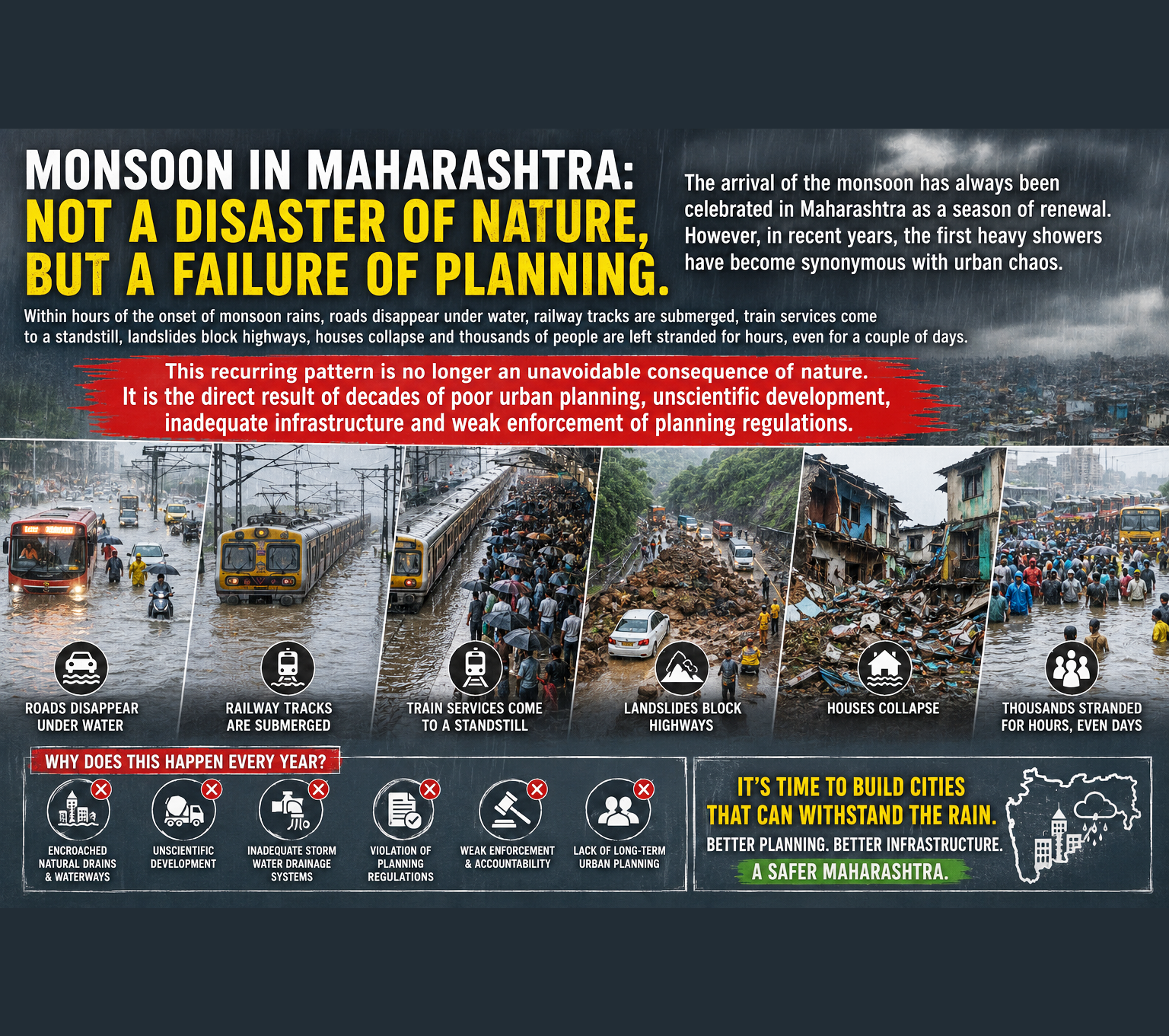
The first major concern is the rapid and often unplanned expansion of cities. Maharashtra has witnessed unprecedented urbanisation over the past three decades. Large residential complexes, commercial buildings, industrial estates and transportation corridors have transformed the landscape. Unfortunately, this development has frequently taken place without adequate attention to natural drainage systems, floodplains, wetlands and water bodies. Streams have been narrowed, rivers encroached upon, ponds filled and mangroves neglected to accommodate construction. The result is that rainwater, which once flowed naturally into rivers and the sea, now accumulates on roads and in residential colonies, causing widespread flooding.
Mumbai offers perhaps the most striking example. Despite investments running into thousands of crores after the devastating floods of 2005, the city continues to witness severe waterlogging after every major spell of rain. Suburban railway services, the city’s lifeline, are repeatedly disrupted because drainage infrastructure has not kept pace with rapid urban growth and increasing rainfall intensity. The sordid tale of the desilting of Mithi river is a sad example of such failure. Similar situations are now being witnessed in Pune, Thane, Nashik and several other urban centres.
Climate change has further aggravated the problem. Meteorological experts have consistently pointed out that rainfall patterns are becoming increasingly erratic. Instead of moderate rainfall spread over several days, cities are now experiencing extremely intense cloudbursts within a short duration. Infrastructure designed decades ago simply cannot cope with such volumes of water. Urban planning standards that were adequate thirty or forty years ago are no longer sufficient. Every new development plan must therefore incorporate updated climate projections, hydrological studies and disaster risk assessments.
Another critical issue is the widespread concretisation of cities. Open spaces that naturally absorbed rainwater have steadily disappeared under concrete roads, parking lots, footpaths and buildings. As a result, rainwater has very little opportunity to percolate into the ground. Surface runoff increases dramatically, overwhelming storm-water drains that were never designed for such enormous flows. Urban planning must therefore encourage permeable pavements, rainwater harvesting, urban forests, green roofs and large public open spaces that function as natural sponges during heavy rainfall.
The problem extends beyond flooding. Every monsoon now brings reports of landslides in the Western Ghats, Konkan region and hill stations. Many of these disasters are linked to indiscriminate quarrying, deforestation and construction on unstable slopes. Roads are carved into hillsides without proper retaining structures, while buildings are permitted in geologically vulnerable areas. The tragic loss of life and repeated disruption of road and rail connectivity underline the need for strict geological assessments before granting development permissions.
Rail infrastructure deserves special attention. Maharashtra’s suburban railway network carries millions of passengers daily and forms the backbone of economic activity, particularly in the Mumbai Metropolitan Region. Yet train services are routinely suspended after heavy rainfall due to track flooding, signalling failures and waterlogging near stations. Long-distance railway routes through the Western Ghats are equally vulnerable to landslides and falling boulders. Strengthening embankments, modernising drainage systems, deploying advanced weather-monitoring technologies and undertaking continuous slope stabilisation projects must become permanent priorities rather than seasonal responses.
Equally important is the need to reform governance. Urban development today involves multiple agencies responsible for roads, drainage, railways, housing, water supply, environment and disaster management. Too often these bodies function in isolation, resulting in fragmented planning and delayed implementation. Maharashtra requires an integrated urban resilience authority that can coordinate planning across departments, ensure accountability and monitor infrastructure projects throughout the year.
Also needed is a quick response mechanism when people lodge their complaints with urban authorities. Even today, it is seen that disaster monitoring cells of municipalities toss responsibility from one department to another, wasting precious time and thus resulting in aggravated difficulties.
Technology should also play a central role in future planning. Geographic Information Systems (GIS), satellite imagery, drone mapping, artificial intelligence and digital flood-modelling can accurately identify vulnerable locations before disasters occur. High-resolution mapping of drainage networks, floodplains, landslide-prone zones and coastal vulnerability should guide every future construction approval. Development plans must be based on scientific evidence rather than short-term commercial considerations.
Building regulations also require urgent revision. Developers should be required to provide adequate storm-water management systems within every major project. Rainwater harvesting should become universal rather than optional. Basement parking in flood-prone areas should incorporate advanced flood protection measures. Encroachments on natural watercourses should be removed irrespective of the influence or status of those responsible. Environmental impact assessments must become more rigorous and transparent.
People participation is another essential element. Residents often possess valuable knowledge about recurring flooding locations, blocked drains and vulnerable neighbourhoods. Municipal corporations should establish digital platforms through which people can report hazards, monitor civic works and participate in planning decisions. Public awareness campaigns on waste disposal are equally important, as plastic waste frequently blocks drainage channels during the monsoon.
Financial investment must also reflect the seriousness of the challenge. Instead of repeatedly spending enormous sums on emergency relief, compensation and temporary repairs after every monsoon, the state should prioritise preventive infrastructure. Illegal structures must be removed ruthlessly. Investments in drainage modernisation, flood mitigation, slope stabilisation and climate-resilient urban design will prove far more economical over the long term than the recurring costs of disaster response.
Most importantly, Maharashtra now needs a statewide Urban Development Commission comprising urban planners, hydrologists, environmental scientists, geologists, transport experts, architects, disaster management professionals and economists. The Commission should undertake a thorough review of every major city’s development plan, drainage network, transport infrastructure, land-use policies and environmental safeguards. It should recommend reforms based on scientific evidence and establish uniform standards for climate-resilient urban development across the state.
The recurring scenes witnessed after the very first downpour each monsoon are a stark warning that Maharashtra’s existing model of urban development has reached its limits. Flooded roads, paralysed railway services, landslides, collapsed buildings and stranded commuters are not merely seasonal inconveniences—they represent systemic failures in planning. The state has both the technical expertise and financial capacity to transform its cities into safer, more resilient urban centres.
What is needed now is the political will to undertake a comprehensive overhaul of urban development policies before future monsoons inflict even greater economic losses and human suffering. Maharashtra chief minister Devendra Fadnavis is a dynamic person with a clear vision about the state’s future prosperity and development. Infrastructure for the future needs sustainably and resilience. It is time to exhibit and implement that spirit.
A Column By
Dilip Chaware – Senior Editor
A media professional for 43 years, with extensive experience of writing on
a variety of subjects; he is also a documentary producer and book author.