
Maharashtra in general and Mumbai in particular have made impressive contributions towards consumer protection over the years. With the state’s overall development, talent and investment have been attracted to Maharashtra constantly. Now, another feather is likely to adorn the state’s crown. This is due to a novel proposal submitted to the state government by Mumbai Grahak Panchayat (MGP), which is reputed for its sterling role in extending protection to the general consumer.
Since its inception in 1975, MGP has been striving for consumer empowerment through its innovative approaches that emphasise on consumer rights and fair trade practices. MGP has emerged as one of the largest voluntary consumer organisations in the world and its contribution has been acknowledged by such bodies as the United Nations and the United Nations Conference on Trade and Development (UNCTAD). Under the leadership of its executive president, Adv Shirish Deshpande, MGP, has formally proposed that Mumbai be developed as a Global Hub for resolving cross-border e-commerce disputes through a UN-backed Global Online Dispute Resolution (ODR) Centre.

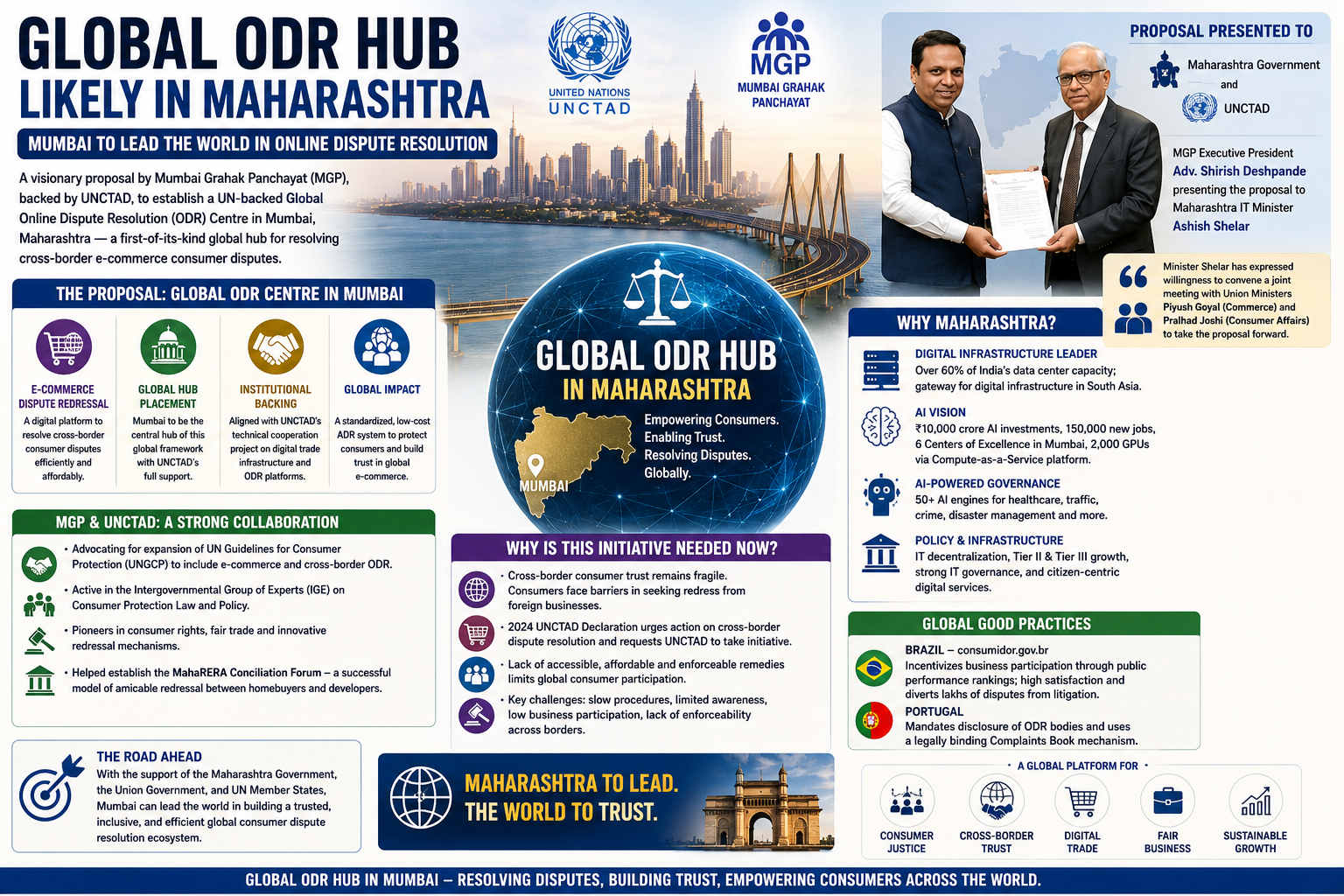
The proposal centers on making Maharashtra the strategic anchor for international consumer trust. It has been presented to both, UNCTAD and the Maharashtra government. Deshpande recently met Maharashtra’s IT minister Ashish Shelar to explain and discuss the proposal. Maharashtra has recently announced its AI policy, which promises to entrench the state’s premier position in the information technology sector. Welcoming it, Deshpande feels that the establishment of the UN Global ODR Hub in Mumbai will become a landmark initiative under the state’s technology roadmap. He said Shelar has expressed willingness to convene a joint meeting with Union Commerce Minister Piyush Goyal and Union Consumer Affairs Minister Pralhad Joshi to take the proposal forward.
Thus, MGP and UNCTAD have collaborated to advocate for a Global ODR mechanism to protect consumers and settle cross-border e-commerce disputes efficiently. Their initiatives focus on making ODR a standardized, low-cost Alternative Dispute Resolution (ADR) system for consumers across the world. The partnership between the two bodies primarily centers on ensuring consumer rights and developing independent redress mechanisms.
– MGP has actively contributed to UNCTAD forums, advocating for the United Nations Guidelines for Consumer Protection (UNGCP) to be expanded to include robust e-commerce and cross-border ODR mechanisms. This ensures that consumers have access to affordable dispute resolution for low-value online purchases. MGP has been highly active in the Intergovernmental Group of Experts (IGE) on Consumer Protection Law and Policy, promoting the voice of consumers in developing markets. UNCTAD acknowledges that MGP has successfully translated ADR principles into local frameworks, famously helping facilitate the MahaRERA Conciliation Forum, which serves as a highly effective, amicable, localized conciliation mechanism between homebuyers and developers.
Key actionable components of this initiative include:
– E-Commerce Consumer Dispute Redressal: A specialized, digital platform aimed at resolving cross-border jurisdictional disputes and consumer complaints efficiently and affordably.
– Global Hub Placement: Establishing the central hub of this global framework in Mumbai—a move that UNCTAD has reportedly received with favourable and positive response.
– Institutional Backing: The initiative aligns with UNCTAD’s technical cooperation project to deliver global digital trading infrastructure and ODR platforms to safeguard consumer rights.
– At the 9th UN Conference on Competition and Consumer Protection held from 7 to 11 July 2025, Deshpande presented a paper on “Cross-border Online Dispute Resolution Opportunities and Challenges.” It was widely welcomed. “After four years of consistent efforts, UNCTAD in July 2025 accepted the proposal in principle and has appealed to UN member states for technical and financial cooperation for its implementation,” MGP says in a statement.
MGP’s sustainable lifestyle approach has garnered international recognition with countries like Zimbabwe adopting the model for economic empowerment and Norway presenting a film in the UN Conference on Sustainable Development.
MGP’s advocacy extends beyond individual grievances to encompass broader systemic issues affecting consumers. Through class action lawsuits, MGP has sought redressal for collective grievances, ensuring that justice is served on a larger scale. MGP has been instrumental in landmark consumer litigation cases, such as the LML Vespa and Paranjape builder, Mango Holidays, where it fought for the rights of aggrieved consumers, resulting in favorable outcomes. MGP represents consumers on various Government bodies like MERC, Electricity CGRF, FSSAI, ASCI and the Coffee Board.
Explaining why this project is needed, Deshpande cites various reasons. For instance, cross-border consumer trust remains fragile. Despite exponential growth in global e-commerce, consumers face significant barriers in seeking redress from foreign businesses. UNCTAD research confirms that the lack of accessible and enforceable remedies inhibits global consumer participation. In 2024, UNCTAD’s member States adopted a Declaration urging action on cross border dispute resolution, requesting UNCTAD to present implementation modalities.
The key challenges to effective consumer dispute resolution systems include inadequate financial and human resources. There are slow and complex procedures in most countries. Fragmented sectoral coverage, limited business participation and compliance as well as low consumer awareness and cross-border coordination are some other factors. Lack of enforceability, especially across-borders adds to the woes of the consumers.
Business engagement remains a persistent issue. In the EU, business participation in alternative dispute resolution mechanisms hovered at 32.60 percent in 2019, with only 28 percent of businesses complying with EU ODR Platform requirements. Many refuse to respond to consumer complaints. Yet, good practices exist. Brazil’s consumidor.gov.br platform incentivizes business participation through public performance rankings, achieving high user satisfaction and diverting hundreds of thousands of disputes from litigation. Portugal mandates disclosure of available ODR bodies and employs a legally binding Complaints Book mechanism.
About why this initiative is required now, Deshpande says the 2024 UNCTAD Declaration on cross-border dispute resolution and redress for consumers reaffirms the urgency of developing scalable, interoperable solutions. It calls on governments, businesses, and civil society to strengthen consumer dispute resolution systems and requests UNCTAD to take the initiative.
As Maharashtra is leading India’s digital transformation, anchoring over 60 percent of the country’s total data center capacity and emerging as the nation’s data center capital, Deshpande is confident that it is ideally suited to house the Global ODR Hub.
With massive hyperscale deployments by cloud leaders, Maharashtra serves as the primary gateway for digital infrastructure in South Asia, supported by hardware and precision manufacturing facilities like Jabil’s center in Pune.
– Artificial Intelligence (AI) Vision: The state aims to attract Rs.10,000 crore in AI investments, targeting 150,000 new jobs and establishing six Centers of Excellence in Mumbai. A state-backed ‘Compute-as-a-Service’ platform gives researchers and startups access to 2,000 GPUs.
– AI-Powered Governance: Maharashtra is revolutionizing administration through AI. Technologies are being used to synthesize massive government documents, power the ‘Crime OS’ platform, and run the ‘Maha-Vistar’ app, creating over 50 AI engines for use across healthcare, traffic control, and disaster management.
– Policy and Infrastructure: The state actively promotes IT decentralization, encouraging entrepreneurship in Tier II and Tier III cities to bridge the digital divide. Additionally, the state IT department is being fundamentally strengthened to offer frictionless citizen services and boost geospatial planning.
In short, Maharashtra is poised to spearhead the consumer protection movement across the globe through the ODR Centre, as envisioned by Deshpande and favoured by UNCTAD. A push by the Union government will accelerate the creation of such a mechanism in the near future.
A Column By
Dilip Chaware – Senior Editor
A media professional for 43 years, with extensive experience of writing on
a variety of subjects; he is also a documentary producer and book author.