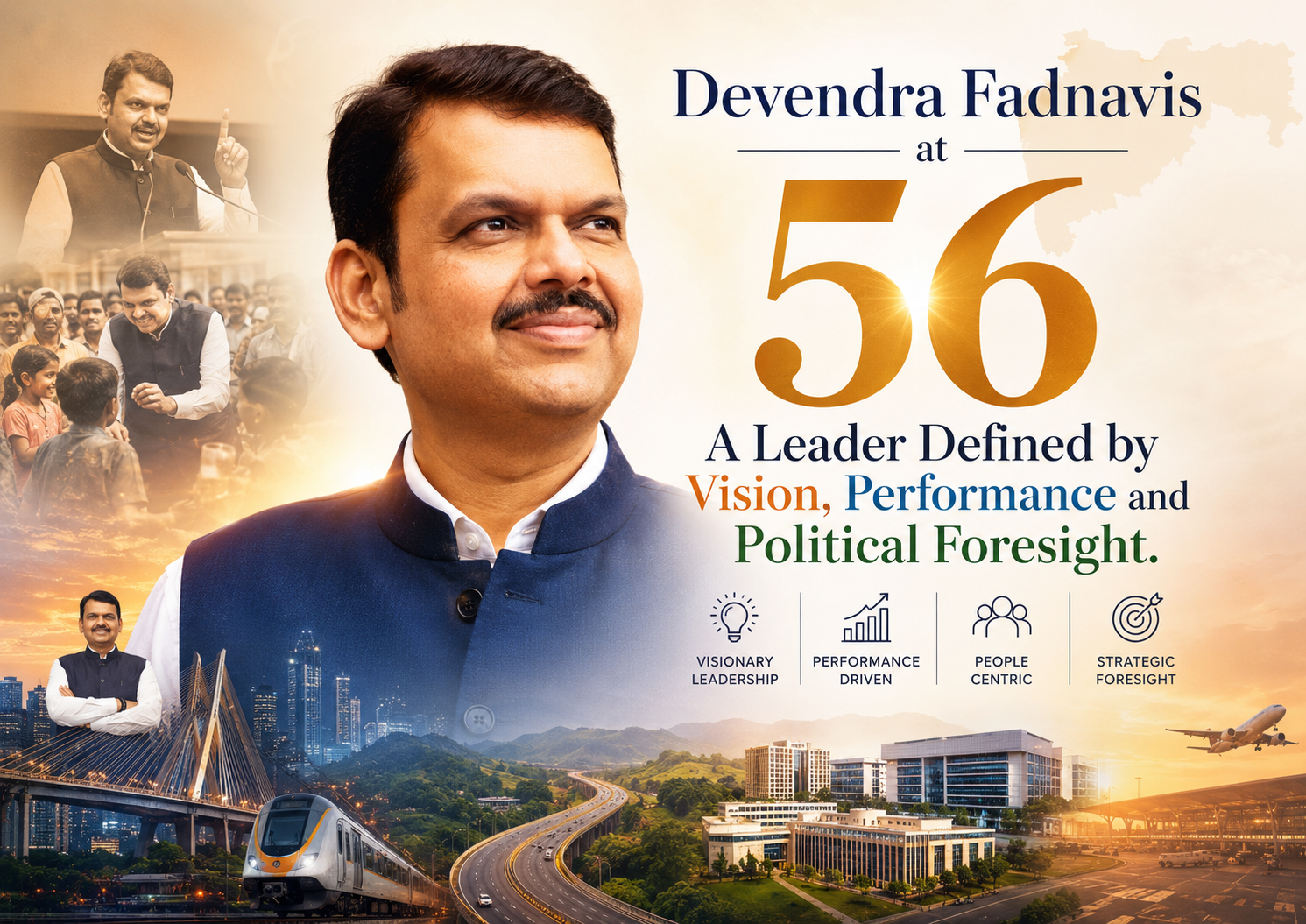
As Maharashtra chief minister, Devendra Fadnavis is celebrating today (22 July) his birthday it is an appropriate moment to reflect on the remarkable political journey of a leader who has steadily emerged as one of India’s most influential state chief ministers. In an era when political leadership is increasingly judged by governance, delivery and public trust rather than rhetoric alone, Fadnavis has distinguished himself through a combination of vision, administrative competence and exceptional political management.
From becoming Maharashtra’s CM in 2014 to navigating one of the most turbulent phases in the state’s political history and returning to lead the government again, his career is marked by resilience, patience and strategic thinking. Few politicians have demonstrated the ability to recover from political setbacks as convincingly as he has.
What sets Fadnavis apart is that he has consistently viewed governance as a long-term exercise rather than merely an electoral one. His focus has extended beyond immediate political gains to building systems and infrastructure that can shape Maharashtra’s future over several decades.
Infrastructure has become the hallmark of his administration. Whether it is the Mumbai Coastal Road, Mumbai Metro expansion, Mumbai Trans Harbour Link, expressways connecting major cities or large-scale investments in ports, logistics and industrial corridors, Maharashtra today is witnessing one of the biggest infrastructure transformations in its history. These projects are intended not only to reduce travel time but also to improve productivity, attract investment and strengthen the state’s competitiveness.
Equally significant has been his emphasis on making Maharashtra a preferred destination for global investment. Through investor-friendly policies, industrial reforms and faster decision-making, the state has continued to attract substantial domestic and foreign investment despite intense competition from other states. His government has recognised that employment generation ultimately depends upon sustained industrial growth.
Perhaps his most ambitious vision is transforming Maharashtra into a trillion-dollar economy. While this objective is undeniably challenging, it provides a clear roadmap around which government departments, industries and investors can align their efforts. Such aspirational targets often create momentum and institutional focus.
Fadnavis has also repeatedly spoken about reducing bureaucratic delays and improving governance through technology and administrative reforms. His concept of “Zero Bureaucracy” reflects an understanding that citizens increasingly expect governments to deliver services efficiently rather than burden them with procedural hurdles. Digital governance, online approvals and greater accountability have gradually become defining features of Maharashtra’s administration.
His tenure has also demonstrated sensitivity towards emerging challenges that many governments tend to address only after they become crises. Climate change, recurring floods, urban infrastructure, water management and disaster preparedness have increasingly occupied policy discussions under his leadership. Maharashtra’s rapidly urbanising landscape requires precisely such forward-looking governance.
Beyond administration lies another quality that distinguishes Devendra Fadnavis: his political management.
Indian politics today demands not merely electoral popularity but also the ability to build alliances, negotiate conflicting interests and maintain organisational discipline. Maharashtra has witnessed extraordinary political realignments over the past few years, producing situations unprecedented in the state’s history.
Throughout these dramatic developments, Fadnavis has displayed remarkable composure. Even during periods when he occupied opposition benches, he remained politically active, consistently raising governance issues while maintaining organisational cohesion within the Bharatiya Janata Party. His eventual return to power demonstrated that political patience can often prove more rewarding than political haste.
His relationship with the BJP’s central leadership has also remained exceptionally strong. Prime Minister Narendra Modi and Union home minister Amit Shah have repeatedly demonstrated confidence in his administrative abilities and political judgement. Such trust has enabled Maharashtra to maintain close coordination with the Union government on several major infrastructure and development projects.
Unlike many regional leaders whose influence remains confined to their respective states, Fadnavis has gradually emerged as a national political figure. His election campaign management, policy interventions and organisational skills are increasingly sought beyond Maharashtra. Within the BJP, he is often regarded as one of the party’s most dependable administrators and capable of handling major responsibilities in future.
Another noteworthy aspect of his leadership is his accessibility. Bureaucrats, industrialists, party workers and ordinary people frequently acknowledge his willingness to engage with issues directly. His command over policy details and ability to respond without excessive dependence on official briefings have earned him respect even among political opponents, nothing to say of the bureaucrats.
No political leader, however, is without critics.
Questions continue to be raised regarding agrarian distress, unemployment, regional disparities and the pace of implementation of certain welfare programmes. Maharashtra also faces enormous challenges relating to urban flooding, affordable housing, environmental conservation and municipal governance. These issues require sustained attention irrespective of who occupies the CM’s chair.
Political opposition is an integral feature of democracy, and Fadnavis continues to face robust criticism from opposition parties. Yet even many of his political adversaries acknowledge his administrative competence and organisational discipline. Such recognition across party lines is not easily earned.
The future appears promising for Devendra Fadnavis.
At just 56 years of age, he combines considerable administrative experience with many active political years still ahead. In national politics, age increasingly favours leaders who possess both governance credentials and electoral appeal. Fadnavis fits that profile comfortably.
If he succeeds in realising even a substantial portion of Maharashtra’s long-term infrastructure and economic agenda, his tenure could well be remembered as one of the state’s most transformative periods since its formation in 1960.
His political future also extends beyond Maharashtra. Given his experience, national visibility and standing within the BJP, it would not be surprising if he eventually assumes larger responsibilities at the national level. Whether that involves a significant role in the Union Government, the party organisation or continued leadership in Maharashtra will depend on political circumstances, but his trajectory clearly points upward.
Leadership is ultimately measured not merely by electoral victories but by the institutions created, opportunities generated and confidence inspired among people. Fadnavis has consistently attempted to position Maharashtra as India’s growth engine through infrastructure, investment, technology and administrative reforms.
As he celebrates his birthday without any fanfare, he stands at an important juncture in his public life. Birthdays provide an opportunity not merely for celebration but also for reflection. For Devendra Fadnavis, they also serve as milestones in an evolving political journey marked by perseverance, performance and purpose. The expectations from him remain high, and so do the opportunities. Few state leaders today possess a comparable combination of administrative experience, political maturity and long-term vision. The next chapter of his career may well prove even more significant than the previous ones.
A Column By
Dilip Chaware – Senior Editor
A media professional for 43 years, with extensive experience of writing on
a variety of subjects; he is also a documentary producer and book author.